

Real C_HANADEV_18 dumps Accurate Questions and Answers with Free and Fast Updates
Real C_HANADEV_18 Quesions Pass Certification Exams Easily
The C-HANADEV-18 certification exam is based on the latest version of SAP HANA 2.0 SPS06. This version of SAP HANA introduces new features and enhancements to the platform, including advanced analytics, machine learning, and data integration capabilities. As a result, individuals who pass the C-HANADEV-18 certification exam will be able to develop and deploy solutions that leverage these new features and capabilities.
SAP C-HANADEV-18 certification exam consists of 80 multiple-choice questions that must be completed within a time limit of 180 minutes. C_HANADEV_18 exam covers various topics, including SAP HANA architecture, data modeling, SQL and SQLScript, programming models, security, and performance optimization. C_HANADEV_18 exam is available in English, Japanese, Korean, and Simplified Chinese languages, and the passing score is 65%.
NEW QUESTION # 38
Which services can you use in SAP HANA, express edition? There are 3 correct answers to this question.
- A. Dynamic tiering
- B. Multi-core and parallelization
- C. Text analytics
- D. System replication
- E. Columnar OLTP and OLAP
Answer: B,C,E
Explanation:
SAP HANA, express edition is a streamlined version of SAP HANA that can run on laptops and other resource-constrained hosts, such as a cloud-hosted virtual machine. SAP HANA, express edition is free to use for in-memory databases up to 32 GB of RAM. SAP HANA, express edition supports the following services:
* Text analytics: This service allows you to analyze unstructured text data, such as documents, emails, tweets, and blogs, using natural language processing techniques. You can use text analytics to extract entities, facts, sentiments, and keywords from text data, and to perform linguistic analysis, such as tokenization, lemmatization, and part-of-speech tagging.
* Multi-core and parallelization: This service allows you to leverage the multi-core architecture and parallel processing capabilities of SAP HANA to optimize the performance of data-intensive operations, such as queries, calculations, and transformations. You can use multi-core and parallelization to distribute the workload across multiple CPU cores and threads, and to execute tasks in parallel or in batches.
* Columnar OLTP and OLAP: This service allows you to store and process data in a columnar format, which enables faster data compression, aggregation, and analysis. You can use columnar OLTP and OLAP to support both transactional and analytical workloads on the same data set, without requiring data duplication or pre-aggregation.
The other options are not correct because:
* A. Dynamic tiering: This service allows you to extend the SAP HANA in-memory database with disk-based tables that can store large volumes of warm or cold data. You can use dynamic tiering to reduce the memory footprint and cost of SAP HANA, while still maintaining query access to the disk-based data. However, dynamic tiering is not supported by SAP HANA, express edition, as it requires additional hardware and software components.
* D. System replication: This service allows you to create and maintain one or more secondary SAP HANA systems that are identical copies of a primary SAP HANA system. You can use system replication to ensure high availability and disaster recovery of SAP HANA, as the secondary systems can take over the role of the primary system in case of a failure. However, system replication is not supported by SAP HANA, express edition, as it requires additional licenses and configuration.
References:
* SAP HANA, express edition, Overview
* SAP HANA, express edition, Features
* SAP HANA, express edition, FAQ
NEW QUESTION # 39
What do you reference in a role template? Please choose the correct answer.
- A. Scopes
- B. Role Collections
- C. Roles
- D. Routes
Answer: B
NEW QUESTION # 40
You configure an OData service for a transactional SAPUI5 application. What is the default data access behavior of the OData service? Please choose the correct answer.
- A. Read: Yes, Create: No Update: Yes Delete: No
- B. Read: Yes Create: Yes Update: Yes Delete: No
- C. Read: Yes Create: Yes Update: Yes Delete: Yes
Answer: C
Explanation:
Read: Yes, Create: No Update: No Delete: No
NEW QUESTION # 41
Which application runtimes are currently supported by the SAP Cloud Application Programming Model?
There are 2 correct answers to this question.
- A. Java
- B. Python
- C. Node.js
- D. Go
Answer: A,C
Explanation:
The SAP Cloud Application Programming Model (CAP) is a framework for developing cloud-native applications based on open standards and best practices. The CAP supports two application runtimes: Node.js and Java. These runtimes provide the core services and libraries for building and running CAP applications, such as data access, authentication, authorization, localization, logging, and testing. The CAP also supports different database technologies, such as SAP HANA, PostgreSQL, and SQLite, and different deployment options, such as SAP Business Technology Platform, SAP HANA Cloud, or Kubernetes. The other options are not correct because:
* A. Go is not a supported application runtime by the CAP. Go is a programming language that can be used to develop cloud-native applications, but it is not part of the CAP framework.
* C. Python is not a supported application runtime by the CAP. Python is a programming language that can be used to develop cloud-native applications, but it is not part of the CAP framework.
References:
* SAP Cloud Application Programming Model, Overview
* SAP Cloud Application Programming Model, Node.js Runtime
* SAP Cloud Application Programming Model, Java Runtime
NEW QUESTION # 42
How do you specify the target currency for currency conversion in calculation views? There are 3 correct answers to this question.
- A. In a table function
- B. In a procedure
- C. With a fixed value
- D. With an input parameter
- E. In a column
Answer: C,D,E
Explanation:
To specify the target currency for currency conversion in calculation views, you can use one of the following methods:
* In a column: You can associate the measure with an attribute column that contains the target currency code. For example, if you have a table that stores the sales amount and the currency code for each transaction, you can use the currency code column as the target currency for the sales amount measure.
* With an input parameter: You can create an input parameter that allows the user to select or enter the target currency code at runtime. For example, if you want to display the sales amount in different currencies based on the user's preference, you can use an input parameter as the target currency for the sales amount measure.
* With a fixed value: You can associate the measure with a fixed currency code that is available in the currency table. For example, if you want to display the sales amount in a single currency, such as USD, you can use a fixed value as the target currency for the sales amount measure. References: Associate Measures with Currency, How to perform Currency Conversion in SAP HANA, Implementing Currency Conversion.
NEW QUESTION # 43
Which tool do you use to create a calculation view in a multi-target application? Please choose the correct answer.
- A. SAP HANA database explorer
- B. SAP Web IDE for SAP HANA
- C. SAP HANA studio
- D. SAP HANA Web-based Development Workbench
Answer: B
Explanation:
To create a calculation view in a multi-target application, you need to use the SAP Web IDE for SAP HANA, which is a web-based development environment that supports the full development lifecycle of SAP HANA applications. The SAP Web IDE for SAP HANA provides graphical and code-based editors for creating calculation views, as well as other database artifacts, such as tables, views, procedures, functions, and more.
You can also use the SAP Web IDE for SAP HANA to create and deploy multi-target applications, which are modular applications that consist of multiple components, such as database modules, Node.js modules, Java modules, HTML5 modules, etc. The other options are incorrect because the SAP HANA database explorer, the SAP HANA Web-based Development Workbench, and the SAP HANA studio do not support the creation of calculation views in a multi-target application. The SAP HANA database explorer is a web-based tool that allows you to browse, manage, and query SAP HANA databases, but not to create or edit database artifacts.
The SAP HANA Web-based Development Workbench is a deprecated tool that was used to create and edit SAP HANA XS classic applications, but not multi-target applications. The SAP HANA studio is a desktop tool that was used to create and edit SAP HANA native applications, but not multi-target applications.
References:
* SAP Web IDE for SAP HANA - SAP Help Portal
* Creating Calculation Views - SAP Help Portal
* Multi-Target Applications - SAP Help Portal
* SAP HANA Database Explorer - SAP Help Portal
* SAP HANA Web-based Development Workbench - SAP Help Portal
* [SAP HANA Studio] - SAP Help Portal
NEW QUESTION # 44
You need to check user input data in your OData request. Which exit type do you use? Please choose the correct answer.
- A. Modification
- B. Consistency
- C. Validation
- D. Verification
Answer: C
Explanation:
To check user input data in your OData request, you need to use the Validation exit type. The Validation exit type is a custom exit that allows you to perform validation of input data and data consistency checks before, after, or during the change operation, or before or after the commit operation. You can specify a maximum of four validation exits per change operation; the exit is registered for the corresponding event with the respective keyword: "before", "after", "precommit" or "postcommit". The validation exit is executed as an SQLScript procedure with a specific signature, and it can raise an error if the input data does not meet the validation criteria1.
The other options, Consistency, Modification, and Verification, are not exit types that you can use to check user input data in your OData request. Consistency is not an exit type, but a property that you can set in the OData service definition to enable or disable the consistency check for the change operations. The consistency check ensures that the data in the database is consistent with the data in the request payload2. Modification is an exit type that allows you to define custom logic to create, update, or delete an entry in an entity set. If a modification exit is specified, it is executed instead of the generic actions provided by the OData infrastructure1. Verification is not an exit type, but a process that you can perform to ensure that the OData service definition is valid and can be activated without errors3. References: 1: Custom Exits for OData Write Requests | SAP Help Portal 2: Consistency Check | SAP Help Portal 3: Verifying the OData Service Definition
| SAP Help Portal
NEW QUESTION # 45
Which of the following are characteristics of database procedures?
- A. Database procedures can have several output parameters, and a mix of both scalar and table types is possible.
- B. Database procedures can have both input and output parameters; however, a parameter CANNOT be both input and output.
- C. If, in the database procedure header, you use the SQL SECURITY INVOKER option, then only the owner of the procedure can start it.
- D. If, in the database procedure header, you use the READS SQL DATA option, then INSERT statements are prohibited; however, dynamic SQL is allowed.
Answer: A,B
Explanation:
According to the SAP HANA SQLScript Reference1, database procedures are subroutines that can be called from SQL statements or other database procedures. Database procedures can have the following characteristics:
* Database procedures can have both input and output parameters; however, a parameter CANNOT be both input and output. Input parameters are used to pass values to the procedure, while output parameters are used to return values from the procedure. A parameter can be either scalar or table type, depending on the data type and cardinality. A parameter cannot be both input and output, because this would create ambiguity and inconsistency in the parameter passing mechanism. For example, you cannot declare a parameter as IN OUT, or assign a value to an input parameter, or read a value from an output parameter. For more information on database procedure parameters, see [Parameters of Database Procedures]2.
* Database procedures can have several output parameters, and a mix of both scalar and table types is possible. Output parameters are used to return values from the procedure to the caller. A procedure can have zero or more output parameters, depending on the purpose and logic of the procedure. Output parameters can be either scalar or table type, depending on the data type and cardinality. A procedure can have a mix of both scalar and table output parameters, as long as they are compatible with the caller's expectations and syntax. For example, you can use a SELECT statement with INTO clause to assign values to scalar output parameters, or use a SELECT statement with RESULT clause to return a table output parameter. For more information on database procedure output parameters, see [Output Parameters of Database Procedures]3.
* If, in the database procedure header, you use the READS SQL DATA option, then INSERT statements are prohibited; however, dynamic SQL is allowed. The READS SQL DATA option is used to indicate that the procedure only reads data from the database, and does not modify or write any data. This option is useful for performance optimization and security enforcement, as it allows the database to apply certain optimizations and checks to the procedure. However, this option also imposes some restrictions on the procedure, such as prohibiting any INSERT, UPDATE, DELETE, or MERGE statements, or any other statements that modify the database state. Dynamic SQL, which is SQL code that is constructed
* and executed at run time, is still allowed, as long as it does not violate the READS SQL DATA option. For more information on the READS SQL DATA option, see [Procedure Header Options]4.
* If, in the database procedure header, you use the SQL SECURITY INVOKER option, then only the owner of the procedure can start it. The SQL SECURITY INVOKER option is used to indicate that the procedure is executed with the privileges of the user who invokes the procedure, rather than the privileges of the user who created the procedure. This option is useful for security enforcement and access control, as it allows the database to apply the appropriate authorization checks and restrictions to the procedure. However, this option does not affect who can start the procedure, as this is determined by the GRANT EXECUTE statement, which grants the execute privilege on the procedure to a specific user or role. The SQL SECURITY INVOKER option only affects how the procedure is executed, not who can execute it. For more information on the SQL SECURITY INVOKER option, see [Procedure Header Options]4.
References: 1: SAP HANA SQLScript Reference 2: Parameters of Database Procedures 3: Output Parameters of Database Procedures 4: Procedure Header Options
NEW QUESTION # 46
Which new components can you use to develop native SAP HANA applications in SAP HANA extended application services, advanced model (XS advanced)?
There are 2 correct answers to this question.
- A. SAP HANA repository
- B. Git repository
- C. SAP Web IDE for SAP HANA
- D. SAP HANA studio
Answer: B,C
Explanation:
SAP HANA extended application services, advanced model (XS advanced) provides a comprehensive platform for the development and execution of micro-service oriented applications, taking advantage of SAP HANA's in-memory architecture and parallel execution capabilities1. XS advanced supports several programming languages and execution environments, such as Java and Node.js, and also provides compatibility with XS classic model2. To develop native SAP HANA applications in XS advanced, you can use the following new components:
* Git repository: XS advanced integrates with Git, a distributed version control system, to manage the source code of your applications. You can use Git to clone, create, push, pull, merge, and branch your projects, and also to collaborate with other developers3.
* SAP Web IDE for SAP HANA: XS advanced provides a web-based integrated development environment (IDE) that allows you to create, edit, test, debug, and deploy your applications. SAP Web IDE for SAP HANA supports various development tools and features, such as editors, wizards, templates, code completion, syntax highlighting, code analysis, debugging, testing, and deployment3.
The other options are not correct because:
* SAP HANA repository: This is a component of XS classic model, not XS advanced. The SAP HANA repository stores the design-time artifacts of your applications, such as views, procedures, and scripts. In XS advanced, the design-time artifacts are stored in Git repositories instead4.
* SAP HANA studio: This is a desktop-based IDE that can be used to develop applications for XS classic model, but not for XS advanced. SAP HANA studio provides various perspectives and tools to access and manage the SAP HANA database, such as the administration console, the catalog, the content, and the security4.
References: 2: SAP HANA Extended Application Services, Advanced Model 4: SAP HANA Extended Application Services 1: SAP HANA extended application services, advanced model 3: SAP HANA Developer Guide for SAP HANA XS Advanced Model (SAP Web IDE)
NEW QUESTION # 47
You implement an asynchronous Node.js service that sends requests to the database. How do you handle the database responses? There are 2 correct answers to this question.
- A. Process the callback methods in the order in which the requests are sent by the service.
- B. Register a callback method for every sent request.
- C. Call a method directly after every send request.
- D. Process the callback methods in the order in which the requests are returned from the database.
Answer: B,D
NEW QUESTION # 48
You need to consume a Node.js service in an SAPUI5 application. In which section of the mta.xml file do you define the variable for the exposed service?
Please choose the correct answer.
- A. In the provides section of the Node.js module
- B. In the path section of the Node.js module
- C. In the requires sect on of the HTML5 module
- D. In the properties sect on of the MTA resources
Answer: C
NEW QUESTION # 49
What characterizes the Node.js environment? There are 2 correct answers to this question.
- A. It is single-threaded.
- B. It is built on Google's V8 JavaScript engine.
- C. It is a client-side design-time environment for JavaScript.
- D. It uses a synchronous programming model.
Answer: A,B
NEW QUESTION # 50
Which elements can you specify with the SAP WeblDE for SAP HANA graphical editor for Core Data Services data models? There are 3 correct answers to this question.
- A. Entity
- B. Procedure
- C. Context
- D. Synonym
- E. Association
Answer: A,C,E
NEW QUESTION # 51
You need to create a native SAP HANA application that fully leverages the SAP HANA platform. How do you implement data-intensive calculations?
Please choose the correct answer.
- A. Distribute calculations between application layer and presentation layer.
- B. Push the calculations onto the presentation layer.
- C. Push the calculations onto the database layer
- D. Push the calculations onto the application layer.
Answer: C
Explanation:
To create a native SAP HANA application that fully leverages the SAP HANA platform, you should implement data-intensive calculations on the database layer, using SQLScript or calculation views. SQLScript is a scripting language that allows you to write stored procedures, functions, and triggers that perform complex calculations and data transformations on the SAP HANA database. Calculation views are graphical or scripted views that define data models based on tables, views, or other calculation views, and apply filters, joins, aggregations, and other operations on the data. By pushing the calculations onto the database layer, you can take advantage of the in-memory processing, parallelization, and optimization capabilities of SAP HANA, and reduce the data transfer and network latency between the application layer and the database layer123.
The other options are not correct because they do not fully leverage the SAP HANA platform, and they may result in poor performance, high resource consumption, and increased complexity. Pushing the calculations onto the application layer means that you use a programming language, such as Java or Node.js, to perform the calculations on the application server, which may not be as efficient or scalable as the database server. Pushing the calculations onto the presentation layer means that you use a UI framework, such as SAPUI5 or SAP Fiori, to perform the calculations on the client device, such as a browser or a mobile device, which may not have enough processing power or memory to handle large or complex data sets. Distributing the calculations between the application layer and the presentation layer means that you split the calculations into different parts and execute them on different layers, which may introduce inconsistency, redundancy, and dependency issues. References:
* SAP HANA Platform, SAP HANA SQL and System Views Reference, SQLScript Guide
* SAP HANA Platform, SAP HANA Modeling Guide for SAP HANA Web Workbench, Calculation Views
* SAP HANA Platform, Developing Applications with SAP HANA Cloud Platform, Developing Multi-Target Applications, Developing Database Modules
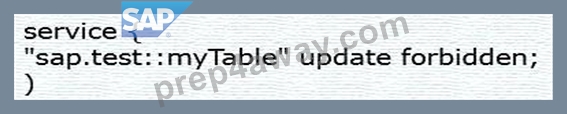
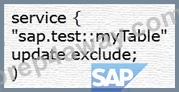
NEW QUESTION # 52
Which OData service do you use to prevent changes to existing line items of the sap.test :myTable table?
Please choose the correct answer.
- A.

- B.
- C.

- D.
Answer: A
Explanation:
To prevent changes to existing line items of the sap.test::myTable table, you can use the OData service that specifies the update authorization as no-authorization for the table. This means that the OData service does not allow any update operations on the table, such as PUT, PATCH, or MERGE. The option A shows the code snippet that defines the OData service with this restriction. The other options do not have the update no-authorization clause for the table, and therefore, they do not prevent changes to the existing line items. References: OData Service Authorization, OData Security Considerations.
NEW QUESTION # 53
......
SAP C-HANADEV-18 is a certification exam for professionals who want to become certified development associates with SAP HANA 2.0 SPS06. Certified Development Associate - SAP HANA 2.0 SPS06 certification ensures that the candidate has the knowledge and skills required to develop and deploy applications on the SAP HANA platform. C_HANADEV_18 exam covers a wide range of topics, including SQL and SQLScript, data modeling, security, and application development.
C_HANADEV_18 Dumps are Available for Instant Access: https://certblaster.prep4away.com/SAP-certification/braindumps.C_HANADEV_18.ete.file.html